Table of contents
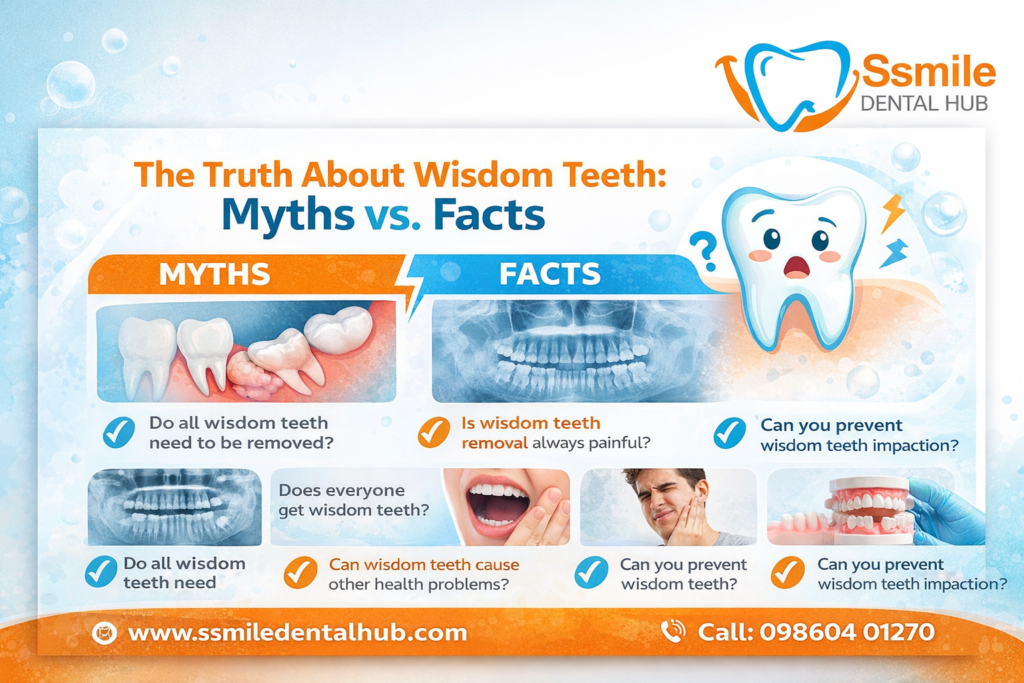
Wisdom teeth – those four third molars right at the back of your mouth — have been the subject of dental myths for generations. Some people think they must always come out. Others believe they cause no trouble whatsoever. The reality, as always, lies somewhere in the middle.
In this blog, we break down the most common myths and share the actual facts so you can make smarter decisions about your oral health.
What Exactly Are Wisdom Teeth?
Wisdom teeth are your third set of molars, and they usually make their appearance between the ages of 17 and 25 — hence the name “wisdom” teeth, since they arrive during early adulthood. Most people develop four wisdom teeth, one in each corner of the mouth. Some people develop fewer, and some never develop them at all.
The real problem begins when there is not enough space in your jaw for them to erupt properly. This can lead to impaction, crowding, infection, and other complications. However — and this is important — not every wisdom tooth is a problem waiting to happen.
Common Myths About Wisdom Teeth – And the Real Facts
Myth 1
Everyone needs their wisdom teeth removed.Fact
Not true. If your wisdom teeth have erupted properly, are fully aligned, and can be cleaned without difficulty, there is no medical reason to remove them. Removal is only recommended when there is impaction, infection, decay, crowding, or persistent pain. Your dentist will assess this through an X-ray and clinical examination before making any recommendation.
Myth 2
Wisdom tooth removal is always extremely painful.Fact
With modern dentistry, the procedure itself is performed under local anaesthesia, so you feel little to no pain during the extraction. There may be some soreness and swelling for a few days after the procedure, which is manageable with prescribed medication. The fear of pain should never be a reason to delay a necessary extraction — as untreated wisdom tooth problems are far more painful in the long run.
Myth 3
Wisdom teeth always cause crowding and misalign your other teeth.Fact
This is a widely believed but largely oversimplified claim. While impacted wisdom teeth can exert pressure on adjacent teeth, research does not conclusively prove that wisdom teeth are the primary cause of crowding in most patients. If you have concerns about your alignment, consult a qualified dentist who can evaluate your specific case. Sometimes, orthodontic treatment addresses crowding more effectively regardless of wisdom teeth.
Myth 4
If there is no pain, the wisdom tooth is fine.Fact
This one is genuinely dangerous. An impacted or partially erupted wisdom tooth can harbour bacteria and develop decay or a cyst without causing obvious pain for months or even years. By the time pain appears, the damage can be significant. This is exactly why regular dental check-ups and X-rays are so important — they can detect problems you cannot feel.
Myth 5
It is better to remove wisdom teeth early, even before they cause problems.Fact
Preventive extraction is not always the right approach. Many dentists worldwide follow a “watchful waiting” strategy — monitoring the wisdom teeth with periodic X-rays rather than rushing into surgery. Unnecessary extractions carry their own risks, including infection, nerve irritation, and dry socket. The decision should always be based on your individual dental anatomy and health history.
Key Facts About Wisdom Teeth You Should Know
Here is a quick summary of what the evidence and clinical experience actually tells us:
- Wisdom teeth that are fully erupted, healthy, and properly aligned generally do not need to be removed.
- Impacted wisdom teeth — those that are unable to fully emerge — are the most common reason for extraction.
- Partially erupted wisdom teeth create a flap of gum tissue called an operculum, which can trap food and bacteria, leading to a painful infection called pericoronitis.
- Wisdom tooth extraction is most straightforward when performed on younger patients, as the roots are not yet fully developed.
- Post-extraction, a condition called “dry socket” can occur if the blood clot is dislodged — this is more common in smokers and people on certain medications.
- Regular dental cleaning and check-ups allow your dentist to monitor wisdom teeth before problems escalate.
- Not everyone develops all four wisdom teeth — some people have fewer, and this is completely normal.
- Pain, swelling, jaw stiffness, or difficulty opening the mouth are signs that a wisdom tooth needs prompt dental attention.
When Should You Actually See a Dentist About Your Wisdom Teeth?
Book an appointment if you experience any of the following:
- Persistent pain or tenderness at the back of the jaw
- Swelling or redness of the gum around the back teeth
- Difficulty opening your mouth or chewing
- A bad taste or bad breath that does not resolve with brushing
- Visible decay or damage to the tooth next to a wisdom tooth
How to Care for Your Wisdom Teeth If They Are Healthy
If your dentist confirms your wisdom teeth are healthy and well-positioned, here is how you keep them that way:
- Brush twice daily and pay special attention to cleaning behind your last molar — this area is easy to miss.
- Use an interdental brush or water flosser to clean the hard-to-reach spaces around wisdom teeth.
- Visit your dentist every six months for a routine check-up and professional cleaning.
- Mention any changes — even minor ones like occasional soreness or unusual sensitivity — during your dental visits.
Get Expert Wisdom Tooth Advice From a Trusted Dentist in Akurdi
If you are unsure about your wisdom teeth or have been experiencing any discomfort, the team at Ssmile Dental Hub, Akurdi is here to help. Led by Dr. Manjusha Dalvi (BDS, Pune University), who brings over 25 years of clinical experience in general and restorative dentistry, Ssmile Dental Hub is one of the most trusted names for anyone looking for a reliable Dentist in Akurdi. Dr. Dalvi and her team believe in honest diagnosis and transparent treatment — which means you will never be recommended a procedure you do not need. Whether it is a routine check-up, a wisdom tooth evaluation, or a more complex dental concern, you can expect personalised care in a comfortable, welcoming environment right here in Akurdi, PCMC.Book Your Consultation Today
Conclusion
Wisdom teeth do not have to be a source of fear or confusion. Like most things in dentistry, the key is staying informed and staying proactive. Not every wisdom tooth needs to come out, but every wisdom tooth deserves to be monitored by a professional.
Understanding the difference between what is a myth and what is a fact helps you have a much more productive conversation with your dentist — and make choices that are genuinely right for your health, not just based on what your neighbour told you.
If it has been a while since you had a dental check-up or if your wisdom teeth have been quietly bothering you, do not wait for the pain to become unbearable. Reach out to Ssmile Dental Hub in Akurdi and take the first step towards clarity and comfort.

Dr. Majusha Dalvi
Since 2006, SSMILE DENTAL CARE in Akurdi, PCMC has been delivering advanced, pain-free dental solutions with a focus on genuine advice and authentic treatment. Led by Dr. Mrs. Manjusha Dalvi (BDS – Pune University, 25+ years of experience), we provide all dental care under one roof. A trusted dentist with 25+ years of clinical excellence in Akurdi, we focus on authentic treatment and lasting results. Our clinic combines genuine care, modern technology, and personalized attention to make every visit pain-free and reassuring.